Overlanding is vehicle-based expedition travel where the journey is the destination. Unlike car camping at a designated campground, overlanding takes you to places accessible only by 4WD vehicle — high-clearance two-tracks, forest roads, and remote desert terrain. Here's how to start.
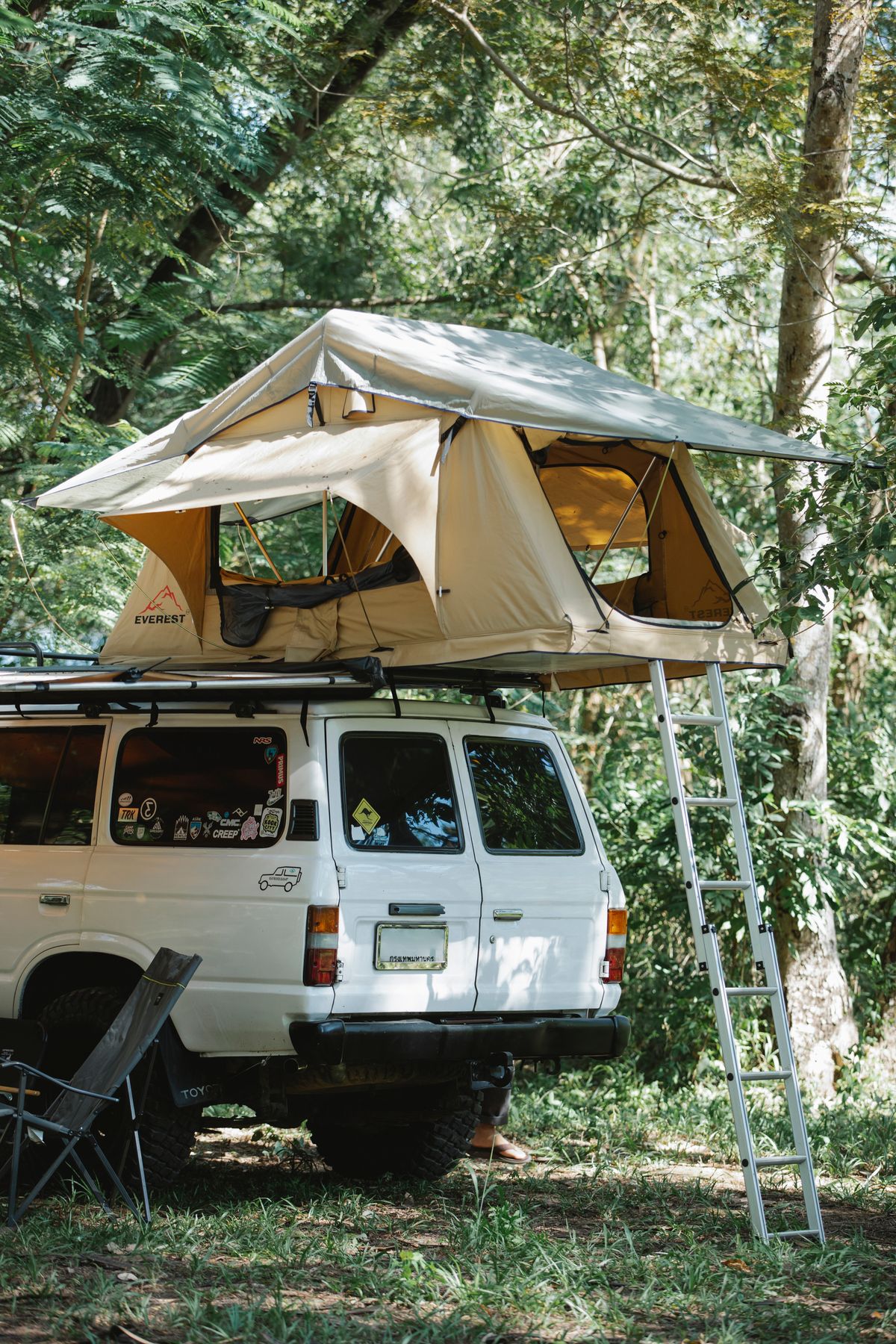
You don't need a $70,000 built truck to start overlanding. Any 4WD or AWD vehicle with reasonable ground clearance can handle the vast majority of forest roads and mild two-tracks that make up most beginner overland routes. The most popular platforms: Toyota 4Runner, Land Cruiser, Tacoma, and Jeep Wrangler/Gladiator. More important than platform is knowing your vehicle's limits and not exceeding them.
If you go off-road, you will eventually get stuck. A basic recovery kit includes: a high-lift jack, a traction board (MAXTRAX or ARB equivalent), a recovery strap rated for your vehicle's weight, and a quality D-ring shackle set. These four items handle the majority of getting-stuck scenarios without another vehicle. A quality shovel is cheap insurance.
Cell coverage disappears quickly on remote routes. Paper maps (National Forest maps, BLM maps) are the non-technical backup. Gaia GPS is the de facto navigation app for overlanders — downloaded topo maps work completely offline. A Garmin InReach or SPOT satellite communicator allows two-way messaging and SOS signaling anywhere on earth, regardless of cell coverage.
National Forest roads (NFS roads) are the ideal beginner terrain — maintained for passenger vehicle access, well-mapped, and legal for camping in most areas. Start with forest roads rated for high-clearance vehicles rather than 4WD-only routes. Driving forest roads builds vehicle awareness and camping skills before tackling technical terrain. Resources: the National Forest map for your region, Gaia GPS with MVUM (Motor Vehicle Use Map) layer.
Rooftop tents (RTTs) are the defining overland camping setup — they set up in 60 seconds on top of your roof rack and put you above the ground, insects, and moisture. Ground tents are cheaper and lighter for hike-in camping but require more setup on uneven terrain. A fridge/freezer (ARB, Dometic) running off your second battery keeps real food cold for multi-day trips and eliminates cooler ice management.
Entry-level overlanding can be done in any 4WD or AWD vehicle you own with a modest recovery kit ($200–400) and basic camping gear. A full beginner setup (rooftop tent, dual battery, basic recovery kit, navigation) runs $3,000–8,000. Serious builds with lockers, long travel suspension, and high-output alternators run $20,000+. Most beginners start cheap and add gear based on what they actually use.
Not for the majority of forest roads and maintained dirt routes. AWD vehicles with moderate ground clearance handle most beginner overland terrain. For technical 4WD-rated routes (rock crawling, deep mud, steep hills), locking differentials and low-range 4WD are required. Match your routes to your vehicle's capabilities, especially when starting out.
See also: Best Rooftop Tents for 2026 • Best Solar Generators • Best Camping Tents
